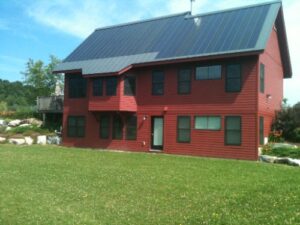
We added two minisplit heat pumps to our house in 2020. They keep the house warm down to outside temps of -18 Fahrenheit. The house…
Adding heat pumps was a big plus.
Submitted by: Richard Hopkins
Adding heat pumps was a big plus.
Submitted by: Richard Hopkins
We added two minisplit heat pumps to our house in 2020. They keep the house warm down to outside temps of -18 Fahrenheit.
The house had an existing forced-air natural gas furnace with ductwork, and we left that in place. The furnace has only had to come on as backup twice in the four years we have had the heat pumps, and that only briefly.
We put one heat pump at either end of the house -- one in the combined living room-dining room- kitchen space, and one in the biggest of the three bedrooms. We also have an energy-recovery ventilation unit, that pulls in outside air for 6 to 10 minutes of every hour, warms it up using a heat exchanger with the house's warm air, and then uses the existing fan and ductwork to distribute that air around the house. This helps to mix the air in the house, to get some warm air to the other two bedrooms. As long as we keep the bedroom doors open, all three bedrooms stay comfortable enough even though the heat pump is only in one of them.
The house is well-insulated and quite tight. This helps with the ability of the heat pumps to keep the house warm even in rooms that don't have a heat pump in them.
We signed up for GMP's time of use rate 22. In winter, this means that on weekdays from 7:30 am to 11:30 am and again from 4:30 to 8:30 pm, we pay more for our electricity; the rest of the time we pay much less. We use the timer function on the heat pumps to turn the heat pump settings down by 2 or 3 degrees during those 4 hour stretches. Sometimes I will turn the heat pumps up a degree or two for the hour before the late-afternoon high-rate period. In any case the heat pumps rarely come on before the four-hour period is up. We use much less than 1/3 of our daily energy during the high-rate periods.
My home was designed to be heated by one 18,000 btu heat pump. The single head in our open living space has kept the whole…
Net-zero home heat pump
Submitted by: Jean Terwilliger
Net-zero home heat pump
Submitted by: Jean Terwilliger
My home was designed to be heated by one 18,000 btu heat pump. The single head in our open living space has kept the whole house comfortable for all but a few hours of the last 6 years. It even kept operating at 20 deg. below zero. Upstairs bedrooms are about 5 degrees cooler in the winter, and because heat rises, the cooling does not really reach them in the summer. A small second unit upstairs would fix this. As long as a system is designed properly, heat pumps work well in this climate and can really cut carbon pollution!
We installed heat pumps over 7 years ago and our oil burner back-up has gone on less than five times total over that timespan. On…
We heat our 1950’s home mostly with heat pumps!
Submitted by: Steve Maier
We heat our 1950’s home mostly with heat pumps!
Submitted by: Steve Maier
We installed heat pumps over 7 years ago and our oil burner back-up has gone on less than five times total over that timespan. On the coldest cloudy days, we do burn a small amount of wood (1/4 to 1/2 of a cord) in a fireplace insert. We love the clean and comfortable heat, and that we also have cooling on the increasing number of hot and humid days.
We built a net zero house in 2008 and opted for a ground source heat pump. The big advantage over an air-to-air heat pump is…
Ground Source Heat Pump
Submitted by: SPENCER PUTNAM
Ground Source Heat Pump
Submitted by: SPENCER PUTNAM
We built a net zero house in 2008 and opted for a ground source heat pump. The big advantage over an air-to-air heat pump is that it provides heat no matter how cold outdoor temperatures get--it draws heat from water in a deep well, which has a constant temperature. The big disadvantage is that our system does not provide air conditioning. It has functioned perfectly for 16 years and provides even heat at much lower cost than a fossil fuel system--most of the energy is produced from our own solar panels, and the system is emissions-free.
We would never go back to internal combustion engine (ICE) cars. We have been driving electric since 2015 and exclusively electric since 2021. In that…
Driving Electric
Submitted by: SPENCER PUTNAM
Driving Electric
Submitted by: SPENCER PUTNAM
We would never go back to internal combustion engine (ICE) cars. We have been driving electric since 2015 and exclusively electric since 2021. In that time access to charging stations has improved a great deal. The networks are expanding more rapidly now, and soon most new cars will have access to the extensive Tesla Supercharger network. EVs are fun to drive, very quiet, almost maintenance-free, and low cost to fuel. The maufacture of EVs does cause more emissions than the manufacture of ICE vehicles, but in about two years of operation the extra emissions caused by EV manufacture (mostly the battery) are outweighed by the totally emissions-free operation.
We love our net zero, super insulated, solar powered house! The extra expense for the solar and weatherization measures added less than 10% to the…
Net Zero Solar Powered House
Submitted by: SPENCER PUTNAM
Net Zero Solar Powered House
Submitted by: SPENCER PUTNAM
We love our net zero, super insulated, solar powered house! The extra expense for the solar and weatherization measures added less than 10% to the construction cost, and we estimate that this premium was paid off in about 12 years through vastly reduced operating costs. It is an all-electric, grid-connected house, and the cost of the energy needed to run the home is very modest--mostly connection fees to the local utility. The extra insulation, high quality windows, and lack of noisy appliances make this a very quiet home.